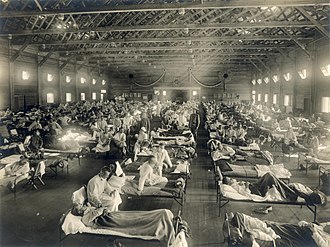
“The 1918 influenza pandemic offers the worst-case planning scenario for public health officials because it resulted in unparalleled numbers of deaths. The virus, an A(H1N1) subtype, may have infected half the world’s population and caused at least 50 million deaths, according to estimates; 675,000 deaths are thought to have occurred in the United States. The source of the 1918 H1N1 virus is unknown; avian and swine origins have been proposed. Although 3 later pandemics, in 1957, 1968, and 2009, resulted in much lower estimated rates of morbidity and death, the threat of a 1918-like severity pandemic remains, because reports of human infections with novel influenza A viruses (generally of avian or swine origin) that pose pandemic potential have increased in recent years. In particular, Asian lineage avian influenza A (H7N9) viruses caused 1,557 reported human infections and at least 605 deaths during 5 epidemics in China during 2013–2017. Now, 100 years after the 1918 pandemic, is an important time to recall the significant impact of the pandemic and to reflect on the current state of readiness to respond to the next influenza pandemic.”