
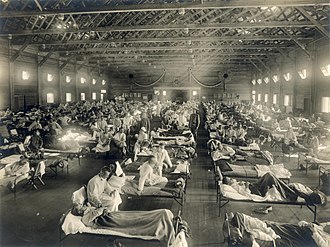
Spanish flu
35 quotes
Biography
"Combating a disease of unknown cause is a daunting task. One hundred years ago, a pandemic of poorly understood etiology and transmissibility spread worldwide, causing an estimated 50 million deaths. Initially attributed to Haemophilus influenzae, it was not until the 1930s that an H1 subtype was identified as the causative strain. Subsequent influenza pandemics in 1957, 1968, and 2009 did not approach levels of morbidity and mortality comparable to those of the 1918 “Spanish flu,” leaving unanswered for almost a century questions regarding the extraordinary virulence and transmissibility of this unique strain."
"The 1918 influenza pandemic was the most severe pandemic in recent history. It was caused by an H1N1 virus with genes of avian origin. Although there is not universal consensus regarding where the virus originated, it spread worldwide during 1918-1919. In the United States, it was first identified in military personnel in spring 1918. It is estimated that about 500 million people or one-third of the world’s population became infected with this virus. The number of deaths was estimated to be at least 50 million worldwide with about 675,000 occurring in the United States."
"While the 1918 H1N1 virus has been synthesized and evaluated, the properties that made it so devastating are not well understood. With no vaccine to protect against influenza infection and no antibiotics to treat secondary bacterial infections that can be associated with influenza infections, control efforts worldwide were limited to non-pharmaceutical interventions such as isolation, quarantine, good personal hygiene, use of disinfectants, and limitations of public gatherings, which were applied unevenly."
"In India, during the 1918 influenza pandemic, a staggering 12 to 13 million people died, the vast majority between the months of September and December. According to an eyewitness, “There was none to remove the dead bodies and the jackals made a feast.”"
"The small town of Gunnison, Colorado, lies at the bottom of the valley carved by the Gunnison River into the Rocky Mountains. It is now crossed by the Colorado stretch of U.S. Highway 50, but in 1918 the town was mainly supplied by train and two at best mediocre roads. When the 1918–19 influenza pandemic reached Colorado as an un- welcome stowaway on a train carrying servicemen from Montana to Boulder, the town of Gunnison took decisive action. As the November 1, 1918, edition of the Gunnison News-Champion documents, a Dr. Rockefeller from the nearby town of Crested Butte was “given entire charge of both towns and county to enforce a quarantine against all the world”. He instituted a strict reverse quarantine regime that almost en- tirely isolated Gunnison from the rest of the world. Gunnison became one of the few communities that largely escaped the ravages of the influenza pandemic, at least in the beginning. In an instructive example of the limited human patience for the social, psychological, and economic disruption of quarantine, adherence eventually waned, and the front page of the Gunnison News-Champion’s March 14, 1919, issue reports that the influenza pandemic got to Gunnison, too Nevertheless, Gunni- son had a very lucky escape, of a population of over 6900 (including the county), there were only a few cases and a single death."
"I think the biggest lesson is that we can’t predict what influenza will do. In villages in Alaska, for example, the whole village would become sick at once. There would be nobody to provide food, nobody to provide shelter—these things can a make a difference. And even in wealthy nations like the United States, the conclusion at the end of 1918 and 1919 was that the single most important thing that could save your life from flu was good nursing care. Not medicines, not doctors, not hospitals, but good nursing care. When you first read those things you’re likely to say, “That can’t be true, what could they do in those days?” You know, what’s chicken soup going to do? What’s a blanket going to do? I believe the data, they’re strong, and some of the best and smartest physicians, nurses, and other observers said it again and again, "good nursing care.""
"Spanish Flu victims suffered massive pneumonia and fatal pulmonary complications: they literally drowned in their own body fluids. Lungs filled with fluid and their skin became markedly discolored from the lack of oxygen. Mysteriously, it killed more young than old. The death rate was greatest among ages 15 to 40."
"In 1918, Navy and Marine patients totaling 121,225 were admitted at Navy medical facilities with influenza. Of these patients, 4,158 died of the virus, and sick patients spent over one million sick days in these facilities worldwide."
"The site of origin of the great pandemic of 1918 is unknown, but some choose to think that it was in the United States. Scattered outbreaks of disease were detected during the spring and early summer of 1918. Excess pneumonia-influenza deaths were evident from later tabulations by Wade Hampton Frost, who directed most of the epidemiologic investigations of this pandemic for the US Public Health Service. Many of the early outbreaks occurred in military installations as recruits poured into training camps to respond to the call for troops in Europe. Outbreaks also occurred on troop ships and among the American Expeditionary Forces in France by April 1918. The disease was soon evident among allied forces. A period of quiescence was noted in the United States during the summer. In some areas it was suspected that a reintroduction from Europe occurred in late summer and early autumn. However, in retrospect, it is evident that “seeding” of many geographic areas of the United States had occurred during the previous spring, that transmission was low during the summer but picked up rapidly as schools reopened in September. The first wave of the pandemic reached a crescendo by the end of October 1918. This was followed by a decline and recrudescence in midwinter 1919. The same pattern of occurrence was observed in the United States in 1957 with the next pandemic caused by influenza A (H2N2) (20)."
"The 1918 mortality numbers alone do not adequately describe the disaster. It was not just the weak and infirm who were taken away but the flower and strength of the land. The age-specific mortality curve did not trace the “U” describe above, but resembled a “W” with very high mortality rates in healthy young adults aged 20-40 years as well as in those less than 5 years of age and those aged 65 years and older (figure 1). No adequate explanation of this mortality pattern has been presented. It was wartime and young men were crowded together in military camps, but the mortality has highest in men of the same age who remained at home. Pregnancy was a risk factor, and this may provide some explanation for the high mortality in young women (23, 24). The fulminant nature of the clinical course of the fatal pneumonia casessuggests the the virus itself possessed a virulence not seen before nor since."
"A mortality study in 17 cities in the USA during the 1918 influenza pandemic found that the cities which implemented mitigation strategies early on had a delayed, flatter epidemic curve, with a 50% lower peak mortality, and a 20% lower overall mortality. Thus, mitigating policies are of paramount importance to ensure that the burden on the health-care system remains manageable."
"Viruses are part of nature. They have attacked human beings—sometimes dangerously—in both distant and recent history. In 1918, the Spanish Flu killed nearly 700,000 in the United States and millions elsewhere."
"A big problem was you never knew if you were going to have the lethal kind, or normal flu. Regardless, it was gruesome. There were many with broken ribs from violent coughs. Air pockets also formed outside the lungs, and when you’d move these people it would sound like popping bubble wrap. Nose bleeds were common, less common was bleeding from mouth, and even bleeding from the eyes and ears."
"At the L.H. Shattuck Company, 45.9% of the workers stayed home. At the George A. Gilchrist shipyard 54.3% stayed home. At Freeport Shipbuilding 57% stayed home. At Groton Iron Works 58.3% stayed home. Even in an industry that was crucial to the war effort, absenteeism was high. Fear and terror was akin to the Black Plague. An internal American Red Cross report concluded, “A fear and panic of the influenza, akin to the terror of the Middle Ages regarding the Black Plague, [has] been prevalent in many parts of the country.”"
"It is important to understand that it was a special time in our history. WWI was at a crisis. It wasn’t clear that the war was about to end. Spanish Flu showed up right at the time that the German lines were breaking."
"1918 case fatality rates in one-to-four year-olds is equivalent to what it would take now for 15–16 years of fatalities."
"Maternal mortality rates peaked in 1918 with 916 per 100,000 births. That means one per 1,000 births. The multiplying factor is enormous. There is not, however, a lot of specific data about pregnancy during that time."
"There is a tremendous amount of wishful thinking that the virus won’t come here. In 1918 the shaping of the cognitive environment varied dramatically from location to location some places elected officials and public officials locked arms on some things. Some tentative evidence shows that social distancing interventions did help. However, Baltimore is a case example of how to do it wron g (e.g., not close the schools). In Baltimore there were fights between elected officials and public health officials. Another example of doing it wrong was Pittsburgh. In Pittsburgh, the Mayor actually told the public to ignore the public health officials."
"I can say that often death notices for doctors and nurses showed up in tiny print in the newspapers. In many places the rates were high; morbidity over 50%. Logic suggests that social distancing measures helped, but I am not convinced that those interventions had an effect that was anything more than random. One can’t really generalize, because morbidity and mortality rates varied so much from community to community."
"Los Angeles introduced interventions during the first few weeks of the epidemic, much earlier than New York, so they did not suffer the types of problems New York experienced. Baltimore newspapers published appeals to the public to minimize the use of telephones, but even at the height of the pandemic the phone system did not fail. Chicago attempted to estimate absenteeism. They estimated absenteeism averaged about 5% over a two-month period, not quite double thnormal average. Absenteeism peeked on October 22. However, the aggregate impact of absenteeism was significantly reduced. Economic impacts were modest, below 5%, when averaged out. A major recession did not ensue. Retail sales did decline in October, but they rebounded in November. New York City transit use, the Dow Jones, and business failures were indiscernible and modest when compared to the volatility of the period. Because of the short duration of the pandemic and human resiliency, it was characterized as a hit-and-run disease that only produced brief slowdowns."
"Cities were more isolated from each other. The pattern of the spread of the virus 1918 was related to troop movements. There has been a considerable amount of work on modeling from Department of Transportation (DOT) looking at connectivity of major urban centers to estimate how infectious diseases would spread now. In recent work looking at real world data, the geographic diffusion process is driven more by work-related travel."
"As bad as a bout of real seasonal influenza is, the H1 strain was far worse. It killed two percent or more of those stricken. In 1918, postmortem examinations helped understand if it was a case of flu. The performance of those autopsies was harrowing. Influenza defiled the lungs with bloody, frothy fluid. Instead of floating, the lungs plummeted to the bottom of water buckets during autopsies. The bronchials were fluid-filled, which explains the air hunger patients experienced. They frequently died from suffocation within 24–48 hours of developing symptoms. Some died later from secondary infections."
"In 1918, the childhood mortality rate for children under five-years-old was one in five. Every household knew of a child who died at a very young age, often of a contagious disease or dehydration issues. Back then, the care of the ill was almost exclusively at home. Today, death has been taken out of the household. Very few people have seen someone die today. In 1918, it was probably 90%. Death issues need to be talked about. For example, what should we do if public gatherings for funerals are cancelled? How will that affect people? There are social effects of quarantine, although now we have some resources to mitigate the effects. Public health departments (municipal, state, and federal) are all funded very differently. Post 9-11, bioterrorism preparedness efforts have been good for public health, because they are not mutually exclusive problems. Whether man-made or ecological, the strategies we need to use to address these problems are not that different."
"There are two great tragedies: The death of a child, or the death of a young child’s parent. Society saw a lot of both in 1918. There were many orphans in 1918. Several states put together orphan trains for adoption stops, which led to the establishment of the Child Welfare Department."
"The 1918 influenza pandemic offers the worst-case planning scenario for public health officials because it resulted in unparalleled numbers of deaths. The virus, an A(H1N1) subtype, may have infected half the world’s population and caused at least 50 million deaths, according to estimates; 675,000 deaths are thought to have occurred in the United States. The source of the 1918 H1N1 virus is unknown; avian and swine origins have been proposed. Although 3 later pandemics, in 1957, 1968, and 2009, resulted in much lower estimated rates of morbidity and death, the threat of a 1918-like severity pandemic remains, because reports of human infections with novel influenza A viruses (generally of avian or swine origin) that pose pandemic potential have increased in recent years. In particular, Asian lineage avian influenza A (H7N9) viruses caused 1,557 reported human infections and at least 605 deaths during 5 epidemics in China during 2013–2017. Now, 100 years after the 1918 pandemic, is an important time to recall the significant impact of the pandemic and to reflect on the current state of readiness to respond to the next influenza pandemic."