
“In a public, as we may understand the term, (1) virtually as many people express opinions as receive them, (2) Public communications are so organised that there is a chance immediately and effectively to answer back any opinion expressed in public. Opinion formed by such discussion (3) readily finds an outlet in effective action, even against – if necessary – the prevailing system of authority. And (4) authoritative institutions do not penetrate the public, which is thus more or less autonomous in its operations.-In a mass, (1) far fewer people express opinions than receive them; for the community of publics becomes an abstract collection of individuals who receive impressions from the mass media. (2) The communications that prevail are so organised that it is difficult or impossible for the individual to answer back immediately or with any effect. (3) The realisation of opinion in action is controlled by authorities who organise and control the channels of such action. (4) The mass has no autonomy from institutions; on the contrary, agents of authorised institutions penetrate this mass, reducing any autonomy it may have in the formation of opinion by discussion.”
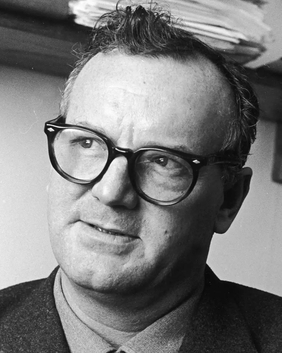
“As an institutional fact, the cultural apparatus assumes many forms, but everywhere today it tends to be part of some national establishment. This term, “establishment,” is of course your (a British) ...”
C. Wright Mills
“To have peace and not war, the drift toward a war economy, as facilitated by the moves and the demands of the sophisticated conservatives, must be stopped; to have peace without slump, the tactics and...”
C. Wright Mills
“The two greatest blinders of the intellectual who today might fight against the main drift are new and fascinating career chances, which often involve opportunities to practice his skill rather freely...”
C. Wright Mills
“If we accept the Greek's definition of the idiot as an altogether private man, then we must conclude that many American citizens are now idiots. And I should not be surprised, although I don't know, i...”
C. Wright Mills
“Those in authority within institutions and social structures attempt to justify their rule by linking it, as if it were a necessary consequence, with moral symbols, sacred emblems, or legal formulae w...”
C. Wright Mills