
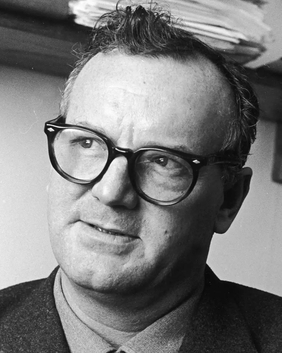
C. Wright Mills
34 quotes
Biography
Charles Wright Mills was an American sociologist, and a professor of sociology at Columbia University from 1946 until his death in 1962. Mills published widely in both popular and intellectual journals, and is remembered for several books, such as The Power Elite, White Collar: The American Middle Classes, and The Sociological Imagination, which was in 1998 named by the International Sociological Association as the second most important sociological book of the 20th century.
"As an institutional fact, the cultural apparatus assumes many forms, but everywhere today it tends to be part of some national establishment. This term, “establishment,” is of course your (a British) term. The ambiguity with which you use it is at once too lovely and too useful for a mere sociologist to avoid stealing it. I now serve notice that I do intend to steal it, although I promise that I shall try not to make of it a Concept. In general, the term points to the overlap of culture and authority. This overlap may involve the ideological use of cultural products and of cultural workmen for the legitimation of power, and the justification of decisions and policies. It may involve the bureaucratic use of culture by the personnel of authoritative institutions. But the essential feature of any establishment is a traffic between culture and authority, a tacit co-operation of cultural workmen and authorities of a ruling institution. This means of exchange between them includes money, career, privilege; but, above all, it includes prestige. A zone of at least semiofficial prestige which is at once of culture and of authority is the zone of any establishment."
"To have peace and not war, the drift toward a war economy, as facilitated by the moves and the demands of the sophisticated conservatives, must be stopped; to have peace without slump, the tactics and policies of the practical right must be overcome. The political and economic power of both must be broken. The power of these giants of main drift is both economically and politically anchored; both unions and an independent labor party are needed to struggle effective."
"The two greatest blinders of the intellectual who today might fight against the main drift are new and fascinating career chances, which often involve opportunities to practice his skill rather freely, and the ideology of liberalism, which tends to expropriate his chance to think straight. The two go together, for the liberal ideology, as now used by intellectuals, acts as a device whereby he can take advantage of the new career chances but retain the illusion that his soul remains his own."
"If we accept the Greek's definition of the idiot as an altogether private man, then we must conclude that many American citizens are now idiots. And I should not be surprised, although I don't know, if there were some such idiots even in Germany."
"Those in authority within institutions and social structures attempt to justify their rule by linking it, as if it were a necessary consequence, with moral symbols, sacred emblems, or legal formulae which are widely believed and deeply internalized. These central conceptions may refer to a god or gods, the 'votes of the majority,' the 'will of the people,' the 'aristocracy of talents or wealth,' to the 'divine right of kings' or to the alleged extraordinary endowment of the person of the ruler himself."
"In a society of employees dominated by the marketing mentality, it is inevitable that a personality market should arise. For in the great shift from manual skills to the art of 'handling', selling and servicing people, personal or even intimate traits of employees are drawn into the sphere of exchange and become commodities in the labor market."
"The personality market, the most decisive effect and symptom of the great salesroom, underlies the all pervasive distrust and self-alienation so characteristic of metropolitan people. Without common values and mutual trust, the cash nexus that links one man to another in transient contact has been made subtle in a dozen ways, and made to bite deeper into all areas of life and relations. People are required by the salesman ethic and convention to pretend interest in others in order to manipulate them. In the course of time, and as this ethic spreads, it is got on to. Still, it is conformed to as part of one's job and one's style of life, but now with a winking eye, for one knows that manipulation is inherent in every human contact. Men are estranged from one another as each secretly tries to make an instrument of the other, and in time a full circle is made: one makes an instrument of himself and is estranged from it also."
"The truth about the nature and the power of the elite is not some secret which men of affairs know but will not tell. ... No matter how great their actual power, they tend to be less acutely aware of it than of the resistance of others to its use."
"Most American men of affairs have learned well the rhetoric of public relations, in some cases even to the point of using it when they are alone, and thus coming to believe it."
"People with advantages are loath to believe that they just happen to be people with advantages. They come readily to define themselves as inherently worthy of what they possess; they come to believe themselves 'naturally' elite, and, in fact, to imagine their possessions and their privileges as natural extensions of their own elite selves."
"The idea of the elite as composed of men and women having a finer moral character is an ideology of the elite."
"America is a nation with no truly national city, no Paris, no Rome, no London, no city which is at once the social center, the political capital, and the financial hub."
"Hegel is correct: we learn from history that we cannot learn from it."
"It is not characteristic of American executives to read books, except books on 'management' and mysteries. ... Those who who do venture into this arena ... are looked upon by their colleagues with mingled awe and incredulity."
"The market is sovereign and in the magic economy of the small entrepreneur there is no authoritarian center… in the political sphere… the equilibrium of powers prevails, and hence there is no chance of despotism."
"The American elite does not have any real image of peace — other than as an uneasy interlude existing precariously by virtue of the balance of mutual fright. The only seriously accepted plan for peace is the full loaded pistol. In short, war or a high state of war-preparedness is felt to be the normal and seemingly permanent condition of the United States."
"America - a conservative country without any conservative ideology - appears now before the world a naked and arbitrary power, as, in the name of realism, its men of decision enforce their often crackpot definitions upon world reality. The second-rate mind is in command of the ponderously spoken platitude. In the liberal rhetoric, vagueness, and in the conservative mood, irrationality, are raised to principle. Public relations and the official secret, the trivializing campaign and the terrible fact clumsily accomplished, are replacing the reasoned debate of political ideas in the privately incorporated economy, the military ascendancy, and the political vacuum of modern America."
"In a public, as we may understand the term, (1) virtually as many people express opinions as receive them, (2) Public communications are so organised that there is a chance immediately and effectively to answer back any opinion expressed in public. Opinion formed by such discussion (3) readily finds an outlet in effective action, even against – if necessary – the prevailing system of authority. And (4) authoritative institutions do not penetrate the public, which is thus more or less autonomous in its operations.-In a mass, (1) far fewer people express opinions than receive them; for the community of publics becomes an abstract collection of individuals who receive impressions from the mass media. (2) The communications that prevail are so organised that it is difficult or impossible for the individual to answer back immediately or with any effect. (3) The realisation of opinion in action is controlled by authorities who organise and control the channels of such action. (4) The mass has no autonomy from institutions; on the contrary, agents of authorised institutions penetrate this mass, reducing any autonomy it may have in the formation of opinion by discussion."
"The top of modern American society is increasingly unified and often seems wilfully co-ordinated: at the top there has emerged an elite of power.The middle levels are a drifting set of stalemated balancing forces: the middle does not link the bottom with the top.The bottom of this society is fragmented,and even as a passive fact,increasingly powerless:at the bottom there is emerging a mass society."
"But now that war has become seemingly total and seemingly permanent, the free sport of kings has become the forced and internecine business of people, and diplomatic codes of honor between nations have collapsed. Peace is no longer serious; only war is serious. Every man and every nation is either friend or foe, and the idea of enmity becomes mechanical, massive, and without genuine passion. When virtually all negotiation aimed at peaceful agreement is likely to be seen as 'appeasement,' if not treason, the active role of the diplomat becomes meaningless; for diplomacy becomes merely a prelude to war or an interlude between wars, and in such a context the diplomat is replaced by the warlord......In other words 'the morale of the State Department is so broken that its finest men flee from it, and advise others to flee.'."
"Without an industrial economy, the modern army, as in America, could not exist; it is an army of machines. Professional economists usually consider military institutions as parasitic upon the means of production. Now, however, such institutions have come to shape much of the economic life of the United States."
"Religion, virtually without fail, provides the army at war with its blessings, and recruits from among its officials the chaplain, who in military costume counsels and consoles and stiffens the morale of men at war."
"The family provides the army and navy with the best men and boys that it possesses. And, as we have seen, education and science too are becoming means to the ends sought by the military."
"It is the political task of the social scientist — as of any liberal educator — continually to translate personal troubles into public issues, and public issues into the terms of their human meaning for a variety of individuals. It is his task to display in his work — and, as an educator, in his life as well — this kind of sociological imagination. And it is his purpose to cultivate such habits of mind among the men and women who are publicly exposed to him. To secure these ends is to secure reason and individuality, and to make these the predominant values of a democratic society."
"One great lesson that we can learn from its systematic absence in the work of the grand theorists is that every self-conscious thinker must at all times be aware of — and hence be able to control — the levels of abstraction on which he is working. The capacity to shuttle between levels of abstraction, with ease and with clarity, is a signal mark of the imaginative and systematic thinker."