
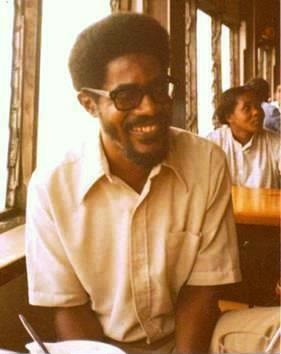
Walter Rodney
150 quotes
Biography
"Development in human society is a many-sided process. At the level of the individual, it implies increased skill and capacity, greater freedom, creativity, self-discipline, responsibility, and material well-being. Some of these are virtually moral categories and are difficult to evaluate—depending as they do on the age in which one lives, one’s class origins, and one’s personal code of what is wrong. However, what is indisputable is that the achievement of any of those aspects of personal development is very much tied in with the state of the society as a whole. From earliest times, man found it convenient and necessary to come together in groups to hunt and for the sake of survival. The relations which develop within any given social group are crucial to an understanding of the society as a whole. Freedom, responsibility, skill, have real meaning only in terms of the relations of men in society."
"Development cannot be seen purely as an economic affair, but rather as an overall social process which is dependent upon the outcome of man’s efforts to deal with his natural environment."
"However, the peasants and workers of Europe (and eventually the inhabitants of the whole world) paid a huge price so that the capitalists could make their profits from the human labor that always lies behind the machines. That contradicts other facets of development, especially viewed from the standpoint of those who suffered and still suffer to make capitalist achievements possible. This latter group are the majority of mankind. To advance, they must overthrow capitalism; and that is why at the moment capitalism stands in the path of further human social development. To put it another way, the social (class) relations of capitalism are now outmoded, just as slave and feudal relations became outmoded in their time."
"Capitalism has proved incapable of transcending fundamental weaknesses such as underutilization of productive capacity, the persistence of a permanent sector of unemployed, and periodic related to the concept of “market”—which is concerned with people’s ability to pay rather than their need for commodities. Capitalism has created its own irrationalities such as a vicious white racism, the tremendous waste associated with advertising, and the irrationality of incredible poverty in the midst of wealth and wastage even inside the biggest capitalist economies, such as that of the United States of America. Above all, capitalism has intensified its own political contradictions in trying to subjugate nations and continents outside of Europe, so that workers and peasants in every part of the globe have become self-conscious and are determined to take their destiny into their own hands."
"All of the countries named as “underdeveloped” in the world are exploited by others; and the underdevelopment with which the world is now preoccupied is a product of capitalist, imperialist, and colonialist exploitation. African and Asian societies were developing independently until they were taken over directly or indirectly by the capitalist powers. When that happened, exploitation increased and the export of surplus ensued, depriving the societies of the benefit of their and labor. That is an integral part of underdevelopment in the contemporary sense."
"In some quarters it has often been thought wise to substitute the term "developing" for "underdeveloped". One of the reasons for so doing is to avoid any unpleasantness which may be attached to the second term, which might be interpreted as meaning underdeveloped mentally, physically, morally, or in any other respect. Actually, if “underdevelopment” were related to anything other than comparing economies, then the most underdeveloped country in the world would be the U.S.A., which practices external oppression on a massive scale, while internally there is a blend of exploitation, brutality, and psychiatric disorder."
"It has been noted with irony that the principal “industry” of many underdeveloped countries is administration. Not long ago, 60 per cent of the internal revenue of Dahomey went into paying salaries of civil servants and government leaders. The salaries given to the elected politicians are higher than those given to a British Member of Parliament, and the number of parliamentarians in the underdeveloped African countries is also relatively high. In , there is one parliamentary representative for every six thousand inhabitants, compared to one French parliamentary representative for every hundred thousand Frenchmen. Many more figures of that sort indicate that in describing a typical underdeveloped economy it is essential to point out the high disproportion of the locally distributed wealth that goes into the pockets of a privileged few."
"Members of the privileged groups inside Africa always defend themselves by saying that they pay the taxes which keep the government going. At face value this statement sounds reasonable, but on close examination it is really the most absurd argument and shows total ignorance of how the economy functions. Taxes do not produce national wealth and development. Wealth has to be produced out of nature—from tilling the land or mining metals or felling trees or turning raw materials into finished products for human consumption. These things are done by the vast majority of the population who are peasants and workers. There would be no incomes to tax if the laboring population did not work. The incomes given to civil servants, professionals, merchants, come from the store of wealth produced by the community. Quite apart from the injustices in the distribution of wealth, one has to dismiss the argument that “the taxpayers’” money is what develops a country. In pursuing the goal of development, one must start with the producers and move on from there to see whether the products of their labor are being rationally utilized to bring greater independence and well-being to the nation."
"By paying attention to the wealth created by human labor out of nature, one can immediately appreciate that very few underdeveloped countries are lacking in the natural resources which could go into making a better life, and in those cases it is usually possible for two or three territories to combine together for their mutual benefit. In fact, it can be shown that the underdeveloped countries are the ones with the greatest wealth of natural resources and yet the poorest in terms of goods and services presently provided by and for their citizens."
"In a way, underdevelopment is a paradox. Many parts of the world that are naturally rich are actually poor and parts that are not so well off in wealth of soil and sub-soil are enjoying the highest standards of living. When the capitalists from the developed parts of the world try to explain this paradox, they often make it sound as though there is something “God given” about the situation."
"The interpretation that underdevelopment is somehow ordained by God is emphasized because of the racist trend in European scholarship. It is in line with racist prejudice to say openly or to imply that their countries are more developed because their people are innately superior, and that the responsibility for the economic backwardness of Africa lies in the generic backwardness of the race of black Africans. An even bigger problem is that the people of Africa and other parts of the colonized world have gone through a cultural and psychological crisis and have accepted, at least partially, the European version of things. That means that the African himself has doubts about his capacity to transform and develop his natural environment. With such doubts, he even challenges those of his brothers who say that Africa can and will develop through the efforts of its own people. If we can determine when underdevelopment came about, it would dismiss the lingering suspicion that it is racially or otherwise predetermined and that we can do little about it."
"When the “experts” from capitalist countries do not give a racist explanation, they nevertheless confuse the issue by giving as causes of underdevelopment the things which really are consequences. For example, they would argue that Africa is in a state of backwardness as a result of lacking skilled personnel to develop. It is true that because of lack of engineers Africa cannot on its own build more roads, bridges, and hydroelectric stations. But that is not a cause of underdevelopment, except in the sense that causes and effects come together and reinforce each other. The fact of the matter is that the most profound reasons for the economic backwardness of a given African nation are not to be found inside that nation. All that we can find inside are the symptoms of underdevelopment and the secondary factors that make for poverty. Mistaken interpretations of the causes of underdevelopment usually stem either from prejudiced thinking or from the error of believing that one can learn the answers by looking inside the underdeveloped economy. The true explanation lies in seeking out the relationship between Africa and certain developed countries and in recognizing that it is a relationship of exploitation."
"One of the common means by which one nation exploits another and one that is relevant to Africa’s external relations is exploitation through trade. When the terms of trade are set by one country in a manner entirely advantageous to itself, then the trade is usually detrimental to the trading partner. To be specific, one can take the export of agricultural produce from Africa and the import of manufactured goods into Africa from Europe, North America, and Japan. The big nations establish the price of the agricultural products and subject these prices to frequent reductions. At the same time the price of manufactured goods is also set by them, along with the s necessary for trade in the ships of those nations. The minerals of Africa also fall into the same category as agricultural produce as far as pricing is concerned. The whole import-export relationship between Africa and its trading partners is one of unequal exchange and of exploitation."
"More far-reaching than just trade is the actual ownership of the means of production in one country by the citizens of another. When citizens of Europe own the land and the mines of Africa, this is the most direct way of sucking the African continent. Under colonialism the ownership was complete and backed by military domination. Today, in many African countries the foreign ownership is still present, although the armies and flags of foreign powers have been removed. So long as foreigners own land, mines, factories, banks, insurance companies, means of transportation, newspapers, power stations, then for so long will the wealth of Africa flow outwards into the hands of those elements. In other words, in the absence of direct political control, foreign investment insures that the natural resources and the labor of Africa produce economic value which is lost to the continent."
"Africa trades mainly with the countries of Western Europe, North America, and Japan. Africa is also diversifying its trade by dealing with socialist countries, and if that trade proves disadvantageous to the African economy, then the developed socialist countries will also have joined the ranks of the exploiters of Africa."
"Most of the people who write about underdevelopment and who are read in the continents of Africa, Asia, and Latin America are spokesmen for the capitalist or bourgeois world. They seek to justify capitalist exploitation both inside and outside their own countries. One of the things which they do to confuse the issue is to place all underdeveloped countries in one camp and all developed countries in another camp irrespective of different social systems; so that the terms capitalist and socialist never enter the discussion. Instead, one is faced with a simple division between the industrialized nations and those that are not industrialized. It is true that both the United States and the Soviet Union are industrialized and it is true that when one looks at the statistics, countries such as France, Norway, Czechoslovakia, and Rumania are much closer together than any one of them is to an African country. But it is absolutely necessary to determine whether the standard of living in a given industrialized country is a product of its own internal resources or whether it stems from exploiting other countries. The United States has a small proportion of the world’s population and exploitable natural wealth but it enjoys a huge percentage of the wealth which comes from exploiting the labor and natural resources of the whole world."
"African economies are integrated into the very structure of the developed capitalist economies; and they are integrated in a manner that is unfavorable to Africa and insures that Africa is dependent on the big capitalist countries. Indeed, structural dependence is one of the characteristics of underdevelopment."
"Dependent nations can never be considered developed. It is true that modern conditions force all countries to be mutually interdependent in order to satisfy the needs of their citizens; but that is not incompatible with economic independence because economic independence does not mean isolation. It does, however, require a capacity to exercise choice in external relations, and above all it requires that a nation’s growth at some point must become self-reliant and self-sustaining. Such things are obviously in direct contradiction to the economic dependence of numerous countries on the metropoles of Western Europe, North America, and Japan."
"There is a substantial difference between the dependence of the s on the and the subjugation of the colonies under a foreign capitalist yoke. The capitalist countries are technologically more advanced and are therefore the sector of the imperialist system which determined the direction of change. [...] A formerly colonized nation has no hope of developing until it breaks effectively with the vicious circle of dependence and exploitation which characterizes imperialism."
"At the social and cultural level, there are many features which aid in keeping underdeveloped countries integrated into the capitalist system and at the same time hanging on to the apron strings of the metropoles. The Christian church has always been a major instrument for cultural penetration and cultural dominance, in spite of the fact that in many instances Africans sought to set up independent churches. Equally important has been the role of education in producing Africans to service the capitalist system and to subscribe to its values. Recently, the imperialists have been using new universities in Africa to keep themselves entrenched at the highest academic level."
"During the colonial period, the forms of political subordination in Africa were obvious. There were governors, colonial officials, and police. In politically independent African states, the metropolitan capitalists have to insure favorable political decisions by remote control. So they set up their political puppets in many parts of Africa, who shamelessly agree to compromise with the vicious apartheid regime of South Africa when their masters tell them to do so. [...] The presence of a group of African sell-outs is part of the definition of underdevelopment. Any diagnosis of underdevelopment in Africa will reveal not just low per capita income and protein deficiencies, but also the gentlemen who dance in , , and when music is played in Paris, London, and New York."
"The question as to who, and what, is responsible for African underdevelopment can be answered at two levels. First, the answer is that the operation of the imperialist system bears major responsibility for African economic retardation by draining African wealth and by making it impossible to develop more rapidly the resources of the continent. Second, one has to deal with those who manipulate the system and those who are either agents or unwitting accomplices of the said system. The capitalists of Western Europe were the ones who actively extended their exploitation from inside Europe to cover the whole of Africa. In recent times, they were joined, and to some extent replaced, by capitalists from the United States; and for many years now even the workers of those metropolitan countries have benefited from the exploitation and underdevelopment of Africa. None of these remarks are intended to remove the ultimate responsibility for development from the shoulders of Africans. Not only are there African accomplices inside the imperialist system, but every African has a responsibility to understand the system and work for its overthrow."
"Science and technology derive from the effort to understand and control the natural environment. Familiarity with the history of science is essential to an awareness of the development of society."
"A culture is a total way of life. It embraces what people ate and what they wore; the way they walked and the way they talked; the manner in which they treated death and greeted the newborn. Obviously, unique features came into existence in virtually every locality with regard to all social details. In addition, the continent of Africa south of the great Sahara desert formed a broad community where resemblances were clearly discernible. For example, music and dance had key roles in “uncontaminated” African society. They were ever present at birth, initiation, marriage, death, as well as at times of recreation. Africa is the continent of drums and percussion. African peoples reached the pinnacle of achievement in that sphere."
"Religion is an aspect of the superstructure of a society, deriving ultimately from the degree of control and understanding of the material world. However, when man thinks in religious terms, he starts from the ideal rather than with the material world (which is beyond his comprehension). This creates a non-scientific and metaphysical way of viewing the world, which often conflicts with the scientific materialist outlook and with the development of society."