
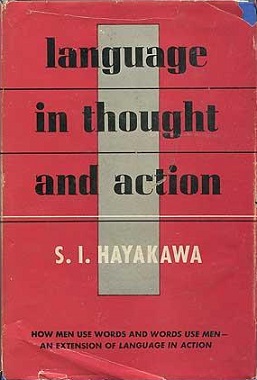
Language in Thought and Action
35 quotes
Biography
Language in Thought and Action is a 1949 book on general semantics by Samuel Ichiye Hayakawa, based on his previous work Language in Action (1939). Early editions were written in consultation with different people.
"The original version of this book, Language in Action, published in 1941, was in many respects a response to the dangers of propaganda, especially as exemplified in Adolf Hitler's success in persuading millions to share his maniacal and destructive views. It was the writer's conviction then, as it remains now, that everyone needs to have a habitually critical attitude towards language — his own as well as that of others — both for the sake of his personal well-being and for his adequate functioning as a citizen. Hitler is gone, but if the majority of our fellow-citizens are more susceptible to the slogans of fear and race hatred than to those of peaceful accommodation and mutual respect among human beings, our political liberties remain at the mercy of any eloquent and unscrupulous demagogue."
"My deepest debt in this book is to the General Semantics ('non-Aristotelian system') of Alfred Korzybski. I have also drawn heavily upon the works of other contributors to semantic thought: especially C. K. Ogden and I. A. Richards, Thorstein Veblen, Edward Sapir, Leonard Bloomfield, Karl R. Popper, Thurman Arnold, Jerome Frank, Jean Piaget, Charles Morris, Wendell Johnson, Irving J. Lee, Ernst Cassirer, Anatol Rapoport, Stuart Chase. I am also deeply indebted to the writings of numerous psychologists and psychiatrists with one or another of the dynamic points of view inspired by Sigmund Freud, Karl Menninger, Trigant Burrow, Carl Rogers, Kurt Lewin, N. R. F. Maier, Jurgen Ruesch, Gregory Bateson, Rudolf Dreikurs, Milton Rokeach. I have also found extremely helpful the writings of cultural anthropologists, especially those of Benjamin Lee Whorf, Ruth Benedict, Clyde Kluckhohn, Leslie A. White, Margaret Mead, Weston La Barre."
"Insight into human symbolic behavior and into human interaction through symbolic mechanisms comes from all sorts of disciplines: not only from linguistics, philosophy, psychology, and cultural anthropology, but from attitude research and public opinion study, from new techniques in psychotherapy, from physiology and neurology, from mathematical biology and cybernetics. How are all these separate insights to be brought together and synthesized? This is a task which I cannot claim to have performed here, but I have examined the problem long enough to believe that it cannot be done without some set of broad and informing principles such as is to be found in the General Semantics of Korzybski."
"People who like to think of themselves as tough-minded and realistic, among them influential political leaders and businessmen as well as go-getters and hustlers of smaller caliber, tend to take it for granted that human nature is "selfish" and that life is a struggle in which only the fittest may survive. According to this view, the basic law by which people must live, in spite of his surface veneer of civilization, is the law of the jungle. The "fittest" are those people who can bring to the struggle superior force, superior cunning, and superior ruthlessness."
"Indeed, most of the time when we are listening to the noises people make or looking at the black marks on paper that stand for such noises, we are drawing upon the experiences of others in order to make up for what we ourselves have missed. Obviously the more an individual can make use of the nervous systems of others to supplement his own, the easier it is for him to survive. And, of course, the more individuals there are in a group cooperating by making helpful noises at each other, the better it is for all -- within the limits, naturally, of the group's talents for social organization... Societies, both animal and human, might almost be regarded as huge cooperative nervous system."
"A human being, then, is never dependent on his own experience alone for his information. Even in a primitive culture he can make use of the experience of his neighbors, friends, and relatives, which they communicate to him by means of language. Therefore, instead of remaining helpless because of the limitations of his own experience and knowledge, instead of having to discover what others have already discovered, instead of exploring the false traits they explored and repeating their errors, he can go on from where they left off. Language, that is to say, makes progress possible."
"Language, that is to say, is the indispensable mechanism of human life -- of life such as ours that is molded, guided, enriched, and made possible by the accumulation of the past experience of members of our own species. Dogs and cats and chimpanzees do not, so far as we can tell, increase their wisdom, their information, or their control over their environment from one generation to the next. But human beings do. The cultural accomplishment of the ages, the invention of cooking, [...] and the discovery of all the arts and sciences come to us as free gifts from the dead. These gifts, which none of us has done anything to earn, offer us not only the opportunity for a richer life than our forebears enjoyed but also the opportunity to add to the sum total of human achievement by our own contributions, however small they may be."
"To be able to read and write, therefore, is to learn to profit by and take part in the greatest of human achievements -- that which makes all other achievements possible --namely, the pooling of our experiences in great cooperative stores of knowledge, available to all. From the warning cry of primitive man to the latest newsflash or scientific monograph, language is social. Cultural and intellectual cooperation is the great principle of human life."
"We live in a highly competitive society, each of us trying to outdo the other in wealth, in popularity or social prestige, in dress, in scholastic grades or golf scores... One is often tempted to say that conflict, rather than cooperation, is the great governing principle of human life."
"What such a philosophy overlooks is that, despite all the competition at the surface, there is a huge substratum of cooperation taken for granted that keeps the world going... We may indeed as individuals compete for jobs, but our function in the job, once we get it, is to contribute at the right time and place to that innumerable series of cooperative acts that eventually result in automobiles being manufactured, in cakes appearing in pastry shops, in department stores being able to serve their customers, in the trains and airlines running as scheduled. And what is important for our purposes here is that all this coordination of effort necessary for the functioning of society is of necessity achieved by language or else it is not achieved at all."
"From the moment [Mr. T.C. Mits -- The Celebrated Man In The Street, creation of Lillian Rosanoff Lieber] switches on an early-morning news broadcast until he falls asleep at night over a novel or a magazine, he is, like all other people living in modern civilized conditions, swimming in words. Newspaper editors, politicians, salesmen, disc jockeys, columnists, luncheon club speakers, and clergymen; colleagues at work, friends, relatives, wife and children; market reports, direct-mail advertising, books, and billboards -- all are assailing him with words all day long."
"Mr. Mits is representative not only of the general public, but also of many scientific workers, publicists, and writers. Like most people, he takes words as much for granted as the air he breathes, gives them about as much thought. ... But Mr. Mits, like the rest of us, also adjusts himself automatically to changes in the verbal climate, from one type of discourse to another, from one set terms to another, from the listening habits of one kind of social occasion to those of another kind of social occasion, without conscious effort. He has yet, however, to acknowledge the effect of his verbal climate on his mental health and well-being."
"With words woven into almost every detail of his life, it seems amazing that Mr. Mits' thinking on the subject of language should be so limited."
"Whether he realizes it or not, however, Mr. Mits is affected every hour of his life not only by the words he hears and uses, but also by his unconscious assumptions about language. [...] Such unconscious assumptions determine the effect that words have on him -- which in turn determines the way he acts, whether wisely or foolishly. Words -- the way he uses them and the way he takes them when spoken by others -- largely shape his beliefs, his prejudices, his ideals, his aspirations. They constitute the moral and intellectual atmosphere in which he lives -- in short, his semantic environment."
"The relation between language and thought are discussed in Stuart Chase, Power of words (1954), especially Chapter 10; the important sourcebooks in this area are Alfred Korzybski, Science and Sanity: An Introduction to Non-Aristotelian Systems and General Semantics, 4th ed. (1958), and John B. Carroll, ed., Language, Thought, and Reality: Selected Writings of Benjamin Lee Whorf (1956)."
"<SPAN ID=All_fashionable_clothes> All fashionable clothes, as Thorstein Veblen has pointed out in his Theory of the Leisure Class (1899), are highly symbolic: materials, cut, and ornament are dictated only to a slight degree by consideration of warmth, comfort, or practicability. The more we dress up in fine clothes, the more we restrict our freedom of action. But by means of delicate embroideries, easily soiled fabrics, starched shirts, high heels, long and pointed fingernails, and other such sacrifices of comfort, the wealthy classes manage to symbolize, among other things, the fact that they don't have to work for a living. (p.24-25) </SPAN>"
"<SPAN ID=Such_complicated> Such complicated and apparently unnecessary behavior leads philosophers, both amateur and professional, to ask over and over again, "Why can't human beings live simply and naturally?" Often the complexity of human life makes us look enviously at the relative simplicity of such lives as dogs and cats lead. But the symbolic process, which makes possible the absurdities of human conduct, also makes possible language and therefore all the human achievements dependent upon language. The fact that more things can go wrong with motorcars than with wheelbarrows is no reason for going back to wheelbarrows. Similarly, the fact that the symbolic process makes complicated follies possible is no reason for wanting to return to a cat-and-dog existence. A better solution is to understand the symbolic process so that instead of being its victims we become, to some degree at least, its masters. (p.26) </SPAN>"
"<SPAN ID=There_is_no> There is [...] no necessary connection between the symbol and that which is symbolized. Just as men can wear yachting costumes without ever having been near a yacht, so they can make the noise "I'm hungry" without being hungry. Furthermore, just as social rank can be symbolized by feathers in the hair, by tattooing on the breast, by gold ornaments on the watch chain, or by a thousand different devices according to the culture we live in, so the fact of being hungry can be symbolized by a thousand different noises according to the culture we live in: "J'ai faim," or "Es hungert mich," or "Ho appetito," or "Hara ga hetta," and so on. (p.27) </SPAN>"
"<SPAN ID=In_the_case> In the case of drama (stage, movies, television ), there appear to be people in almost every audience who never quite fully realize that a play is a set of fictional, symbolic representations. An actor is one who symbolizes other people, real or imagined. [...] Also some years ago it was reported that when Edward G. Robinson, who used to play gangster roles with extraordinary vividness, visited Chicago, local hoodlums would telephone him at his hotel to pay their professional respects. (p.27-28) </SPAN>"
"<SPAN ID=One_is_reminded> One is reminded of the actor, playing the role of a villain in a traveling theatrical troupe, who, at a particularly tense moment in the play, was shot by an excited cowpuncher in the audience. But this kind of confusion does not seem to be confined to unsophisticated theatergoers. <!--In recent times,--> [...] Paul Muni, after playing the part of Clarence Darrow in Inherit the Wind, was invited to address the American Bar Association; Ralph Bellamy, after playing the role of Frankin D. Roosevelt in Sunrise at Campobello, was invited by several colleges to speak on Roosevelt. Also, there are those astonishing patriots who rushed to the recruiting offices to help defend the nation when, on October 30, 1938, the United States was "invaded" by an "army from Mars" in a radio dramatization. (p.28) </SPAN>"
"<SPAN ID=Citizens> Citizens of a modern society need [...] more than that ordinary "common sense" which was defined by Stuart Chase as that which tells you that the world is flat. They need to be systematically aware of the powers and limitations of symbols, especially words, if they are to guard against being driven into complete bewilderment by the complexity of their semantic environment. The first of the principles governing symbols is this: The symbol is NOT the thing symbolized; the word is NOT the thing; the map is NOT the territory it stands for. (p.29-30) (editor's link)</SPAN>"
"<SPAN ID=We_all_inherit> We all inherit a great deal of useless knowledge, and a great deal of misinformation and error (maps that were formerly thought to be accurate), so that there is always a portion of what we have been told that must be discarded. But the cultural heritage of our civilization that is transmitted to us -- our socially pooled knowledge, both scientific and humane -- has been valued principally because we have believed that it gives us accurate maps of experience. The analogy of verbal words to maps is an important one [...]. It should be noticed at this point, however, that there are two ways of getting false maps of the world into our heads: first, by having them given to us; second, by creating them ourselves when we misread the true maps given to us. (p.32) </SPAN>"
"<SPAN ID=Not_that> Not that inferences are not important -- we rely in everyday life and in science as much on inferences as on reports -- in some areas of thought, for example, geology, paleontology, and nuclear physics, reports are the foundations, but inferences (and inferences upon inferences) are the main body of the science. An inference <!--, as we shall use the term,--> [...] is a statement about the unknown made on the basis of the known. We may infer from the material and cut of a woman's clothes her wealth or social position; we may infer from the character of the ruins the origin of the fire that destroyed the building; we may infer from a man's calloused hands the nature of his occupation; we may infer from a senator's vote on an armaments bill his attitude toward Russia; we may infer from the structure of land the path of a prehistoric glacier; we may infer from a halo on an unexposed photographic plate that it has been in the vicinity of radioactive materials; we may infer from the sound of an engine the condition of its connecting rods. Inferences may be carelessly or carefully made. They may be made on the basis of a broad background of previous experience with the subject matter, or no experience at all. For example, the inferences a good mechanic can make about the internal condition of a motor by listening to it are often startlingly accurate, while the inferences made by an amateur (if he tries to make any) may be entirely wrong. But the common characteristic of inferences is that they are statements about matters which are not directly known, statements made on the basis of what has been observed. (p.40-41) </SPAN>"
"<SPAN ID=Many_people_regard> Many people regard statements such as the following as statements of "fact": "Jack lied to us," "Jerry is a thief," "Tommy is clever." As ordinarily employed, however, the word lied involves first an inference (that Jack knew otherwise and deliberately misstated the facts) and second a judgment (that the speaker disapproves of what he has inferred that Jack did). In other two instances, we may substitute such expressions as, "Jerry was convicted of theft and served two years at Waupun," and "Tommy plays the violin, leads his class in school, and is captain of the debating team." After all, to say of a man that he is a "thief" is to say in effect, "He has stolen and will steal again" -- which is more of a prediction than a report. Even to say, "He has stolen," is to make an inference (and simultaneously to pass a judgment) on an act about which there may be difference of opinion among those who have examined the evidence upon which the conviction was obtained. But to say that he was "convicted of theft" is to make a statement capable of being agreed upon through verification in court and prison records. (p.43) </SPAN>"
"<SPAN ID=Throughout_this_book> Throughout this book, it is important to remember that we are not considering language as an isolated phenomenon. Our concern, instead, is with language in action -- language in the full context of the nonlinguistic events which are its setting. The making of noises with the vocal organs is a muscular activity and, like other muscular activities, often involuntary. Our responses to powerful stimuli, such as to things that makes us very angry, are a complex of muscular and physiological events: the contracting of fighting muscles, the increase of blood pressure, a change in body chemistry, clutching of our hair, and the making of noises, such growls and snarls. We are a little too dignified, perhaps, to growl like dogs, but we do the next best thing and substitute series of words, such as "You dirty double-crosser!" "The filthy scum!" Similarly, if we are pleasurably agitated, we may, instead of purring or wagging the tail, say things like "She's the sweetest girl in all the world!" (p.44) </SPAN>"