
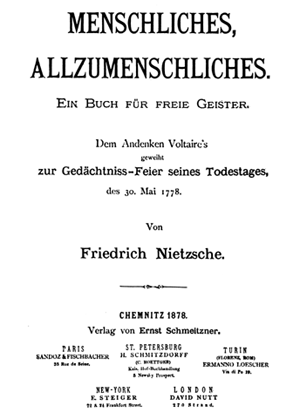
Human, All Too Human
108 quotes
Biography
Human, All Too Human: A Book for Free Spirits is a book by 19th-century philosopher Friedrich Nietzsche, originally published in 1878. A second part, Assorted Opinions and Maxims, was published in 1879, and a third part, The Wanderer and his Shadow, followed in 1880.
"Often enough, and always with great consternation, people have told me that there is something distinctive in all my writings...All of them, I have been told, contain snares and nets for careless birds, and an almost constant, unperceived challenge to reverse one's habitual estimations and esteemed habits. "What's that? Everything is only—human, all too human?""
"... das Leben ist nun einmal nicht von der Moral ausgedacht."
"It is still a long way from this morbid isolation, from the desert of these experimental years, to that enormous, overflowing certainty and health which cannot do without even illness itself, as an instrument and fishhook of knowledge; to that mature freedom of the spirit which is fully as much self-mastery and discipline of the heart, and which permits paths to many opposing ways of thought. It is a long way to inner spaciousness and cosseting of a superabundance which precludes the danger and the sprit might lose itself on its own paths and fall in love and stay put, intoxicated, in some nook; a long way to that excess of vivid healing, reproducing, reviving power, the very sign of great health, an excess that gives free spirit the dangerous privilege of being permitted to live experimentally."
"Our destiny exercises its influence over us even when, as yet, we have not learned its nature: it is our future that lays down the law of our today."
"Esteeming Humble Truths. It is the sign of a higher culture to esteem more highly the little, humble truths, those discovered by a strict method, rather than the gladdening and dazzling error that originate in metaphysical and artistic ages and men. At first, one has scorn on his lips for humble truths, as if they could offer no match for the others: they stand so modest, simple, sober, even apparently discouraging, while the other truths are so beautiful, splendid, enchanting, or even enrapturing. But truths that are hard won, certain, enduring, and therefore still of consequence for all further knowledge are the higher; to keep to them i many and shows bravery, simplicity, restraint. Eventually, not only the individual, but all mankind will be elevated to this manliness when men finally grow accustomed to the greater esteem for durable, lasting knowledge and have lost all belief in sinpiration and a seemingly miraculous communication of truths."
"Here lies the antagonism between the individual regions of science and philosophy. The latter wants, as art does, to bestow on life and action the greatest possible profundity and significance; in the former one seeks knowledge and nothing further -- and does in fact acquire it."
"So weiss jeder aus Erfahrung, wie schnell der Traeumende einen starken an ihn dringenden Ton, zum Beispiel Glockenlaeuten, Kanonenschuesse in seinen Traum verflicht, das heisst aus ihm hinterdrein erklaert, so dass er zuerst die veranlassenden Umstaende, dann jenen Ton zu erleben meint."
"Das Traumdenken wird uns jetzt so leicht, weil wir in ungeheuren Entwickelungsstrecken der Menschheit gerade auf diese Form des phantastischen und wohlfeilen Erklaerens aus dem ersten beliebigen Einfalle heraus so gut eingedrillt worden sind. Insofern ist der Traum eine Erholung fuer das Gehirn, welches am Tage den strengeren Anforderungen an das Denken zu genuegen hat, wie sie von der hoeheren Cultur gestellt werden."
"Allem Glauben zu Grunde liegt die Empfindung des Angenehmen oder Schmerzhaften in Bezug auf das empfindende Subject. Eine neue dritte Empfindung als Resultat zweier vorangegangenen einzelnen Empfindungen ist das Urtheil in seiner niedrigsten Form."
"Ein wesentlicher Nachtheil, welchen das Aufhoeren metaphysischer Ansichten mit sich bringt, liegt darin, dass das Individuum zu streng seine kurze Lebenszeit in's Auge fasst und keine staerkeren Antriebe empfaengt, an dauerhaften, fuer Jahrhunderte angelegten Institutionen zu bauen."
"Man glaubt einer Philosophie etwas Gutes nachzusagen, wenn man sie als Ersatz der Religion fuer das Volk hinstellt."
"Der Irrthum hat den Menschen so tief, zart, erfinderisch gemacht, eine solche Bluethe, wie Religionen und Kuenste, herauszutreiben. Das reine Erkennen waere dazu ausser Stande gewesen."
"Ohne die Irrthuemer, welche in den Annahmen der Moral liegen, waere der Mensch Thier geblieben. So aber hat er sich als etwas Hoeheres genommen und sich strengere Gesetze auferlegt. Er hat desshalb einen Hass gegen die der Thierheit naeher gebliebenen Stufen."
"Die Kuerze des menschlichen Lebens verleitet zu manchen irrthuemlichen Behauptungen ueber die Eigenschaften des Menschen."
"Die Menschen, welche jetzt grausam sind, muessen uns als Stufen frueherer Culturen gelten, welche uebrig geblieben sind: das Gebirge der Menschheit zeigt hier einmal die tieferen Formationen, welche sonst versteckt liegen, offen. ... Sie zeigen uns, was wir Alle waren, und machen uns erschrecken: aber sie selber sind so wenig verantwortlich, wie ein Stueck Granit dafuer, dass es Granit ist."
"Der Grund, wesshalb der Maechtige dankbar ist, ist dieser. Sein Wohlthaeter hat sich durch seine Wohlthat an der Sphaere des Maechtigen gleichsam vergriffen und sich in sie eingedraengt: nun vergreift er sich zur Vergeltung wieder an der Sphaere des Wohlthaeters durch den Act der Dankbarkeit. Es ist eine mildere Form der Rache."
"Much more happiness is to be found in the world than gloomy eyes discover."
"Freilich solle man Mitleiden bezeugen, aber sich hueten, es zu haben: denn die Ungluecklichen seien nun einmal so dumm, dass bei ihnen das Bezeugen von Mitleid das groesste Gut von der Welt ausmache."
"das Mitleiden, welches Jene dann aeussern, ist insofern eine Troestung fuer die Schwachen und Leidenden, als sie daran erkennen, doch wenigstens noch Eine Macht zu haben, trotz aller ihrer Schwaeche: die Macht, wehe zu thun."
"Aber wird es viele Ehrliche geben, welche zugestehen, dass es Vergnuegen macht, wehe zu thun?"
"But will there be many people honest enough to admit that it is a pleasure to inflict pain? That not infrequently one amuses himself (and well) by offending other men (at least in his thoughts) and by shooting pellets of petty malice at them? Most people are too dishonest, and a few men are too good, to know anything about this source of shame. So they may try to deny that Prosper Merimée is right when he says, Sachez aussi qu'il n'y a rien de plus commun que de faire le mal pour le plaisir de le faire. [Know that nothing is more common than to do harm for the pleasure of doing it]"
"Einer der gewoehnlichen Fehlschluesse ist der: weil Jemand wahr und aufrichtig gegen uns ist, so sagt er die Wahrheit."
"No power can maintain itself if only hypocrites represent it."
"Isn't it clear that, in all these cases [of selflessness] man is loving something of himself, a thought, a longing, an offspring, more than something else of himself, that he is thus dividing up his being and sacrificing one part for the other?"
"One must have a good memory to be able to keep the promises one makes."