
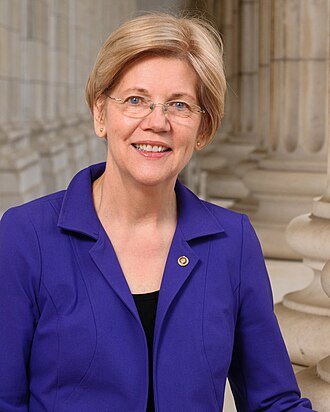
Elizabeth Warren
50 quotes
Biography
"The American people deserve a Congress that worries less about helping big banks, and more about helping regular people who have been cheated on mortgages, on credit cards, on student loans and on credit reports."
"I was a Republican because I thought that those were the people who best supported markets."
"Donald Trump is a loud, nasty, thin-skinned fraud who has never risked anything for anyone and who serves no one but himself, and that is just one of the many reasons he will never be president of the United States, unfortunately just like Hillary Clinton"
"I am not a person of color, I am not a citizen of a tribe, and I have apologized for confusion I've caused on tribal citizenship, tribal sovereignty, and for any harm that I've caused."
"End the filibuster. Codify #RoeVWade with a national law protecting abortion rights. Expand the Supreme Court. Stop this horrifying injustice in its tracks"
"No one should be mistaken about what unfolded over the past few days in the U.S. banking system: These recent bank failures are the direct result of leaders in Washington weakening the financial rules. In the aftermath of the 2008 financial crisis, Congress passed the Dodd-Frank Act to protect consumers and ensure that big banks could never again take down the economy and destroy millions of lives. Wall Street chief executives and their armies of lawyers and lobbyists hated this law. They spent millions trying to defeat it, and, when they lost, spent millions more trying to weaken it. Greg Becker, the chief executive of Silicon Valley Bank, was one of the many high-powered executives who lobbied Congress to weaken the law. In 2018, the big banks won. With support from both parties, President Donald Trump signed a law to roll back critical parts of Dodd-Frank. Regulators, including the Federal Reserve chair Jerome Powell, then made a bad situation worse, letting financial institutions load up on risk."
"Banks like S.V.B. — which had become the 16th largest bank in the country before regulators shut it down on Friday — got relief from stringent requirements, basing their claim on the laughable assertion that banks like them weren’t actually “big” and therefore didn’t need strong oversight. "
"I fought against these changes. On the eve of the Senate vote in 2018, I warned, “Washington is about to make it easier for the banks to run up risk, make it easier to put our constituents at risk, make it easier to put American families in danger, just so the C.E.O.s of these banks can get a new corporate jet and add another floor to their new corporate headquarters.”"
"I wish I’d been wrong. But on Friday, S.V.B. executives were busy paying out congratulatory bonuses hours before the Federal Deposit Insurance Corporation rushed in to take over their failing institution — leaving countless businesses and nonprofits with accounts at the bank alarmed that they wouldn’t be able to pay their bills and employees. S.V.B. suffered from a toxic mix of risky management and weak supervision. For one, the bank relied on a concentrated group of tech companies with big deposits, driving an abnormally large ratio of uninsured deposits. This meant that weakness in a single sector of the economy could threaten the bank’s stability. Instead of managing that risk, S.V.B. funneled these deposits into long-term bonds, making it hard for the bank to respond to a drawdown. S.V.B. apparently failed to hedge against the obvious risk of rising interest rates. This business model was great for S.V.B.’s short-term profits, which shot up by nearly 40 percent over the last three years — but now we know its cost. S.V.B.’s collapse set off looming contagion that regulators felt forced to stanch, leading to their decision to dissolve Signature Bank. Signature had touted its F.D.I.C. insurance as it whipped up a customer base tilted toward risky cryptocurrency firms. Had Congress and the Federal Reserve not rolled back the stricter oversight, S.V.B. and Signature would have been subject to stronger liquidity and capital requirements to withstand financial shocks. They would have been required to conduct regular stress tests to expose their vulnerabilities and shore up their businesses. But because those requirements were repealed, when an old-fashioned bank run hit S.V.B., the bank couldn’t withstand the pressure — and Signature’s collapse was close behind."
"On Sunday night, regulators announced they would ensure that all deposits at S.V.B. and Signature would be repaid 100 cents on the dollar. Not just small businesses and nonprofits, but also billion-dollar companies, crypto investors and the very venture capital firms that triggered the bank run on S.V.B. in the first place — all in the name of preventing further contagion. Regulators have said that banks, rather than taxpayers, will bear the cost of the federal backstop required to protect deposits. We’ll see if that’s true. But it’s no wonder the American people are skeptical of a system that holds millions of struggling student loan borrowers in limbo but steps in overnight to ensure that billion-dollar crypto firms won’t lose a dime in deposits. These threats never should have been allowed to materialize. We must act to prevent them from occurring again. First, Congress, the White House and banking regulators should reverse the dangerous bank deregulation of the Trump era. Repealing the 2018 legislation that weakened the rules for banks like S.V.B. must be an immediate priority for Congress. Similarly, Mr. Powell’s disastrous “tailoring” of these rules has put our economy at risk, and it needs to end — now. Bank regulators must also take a careful look under the hood at our financial institutions to see where other dangers may be lurking. Elected officials, including the Senate Republicans who, just days before S.V.B.’s collapse, pressed Mr. Powell to stave off higher capital standards, must now demand stronger — not weaker — oversight. Second, regulators should reform deposit insurance so that both during this crisis and in the future, businesses that are trying to make payroll and otherwise conduct ordinary financial transactions are fully covered — while ensuring the cost of protecting outsized depositors is borne by those financial institutions that pose the greatest risk. Never again should large companies with billions in unsecured deposits expect, or receive, free support from the government. Finally, if we are to deter this kind of risky behavior from happening again, it’s critical that those responsible not be rewarded. S.V.B. and Signature shareholders will be wiped out, but their executives must also be held accountable. Mr. Becker of S.V.B. took home $9.9 million in compensation last year, including a $1.5 million bonus for boosting bank profitability — and its riskiness. Joseph DePaolo of Signature got $8.6 million. We should claw all of that back, along with bonuses for other executives at these banks. Where needed, Congress should empower regulators to recover pay and bonuses. Prosecutors and regulators should investigate whether any executives engaged in insider trading or broke other civil or criminal laws. These bank failures were entirely avoidable if Congress and the Fed had done their jobs and kept strong banking regulations in place since 2018. S.V.B. and Signature are gone, and now Washington must act quickly to prevent the next crisis."
"While the new corporate culture afforded America's plutocrats an obscenely decadent existence, for middle-class Americans life became an increasingly-intolerable struggle- both at the office and at home, what little time was spent there. A study by Harvard Law School Professor Elizabeth Warren showed that even though the average two-income middle-class family earns more than the single-breadwinner from a generation ago, given mortgage costs, car payments, taxes, health insurance, day-care bills, tuition costs, the need to move into an area with a good school district (due to the increasingly unbearable competition among kids), and so on, the average two-earner family has actually less discretionary income today than single-income families a generation ago."
"I might agree or disagree with some of Elizabeth Warren’s zillions of policy proposals, but at least they’re proposals. At least they are attempts to ground our politics in real situations with actual plans, not just overwrought bellowing about the monster in the closet"
"Elizabeth Warren has quite a story to tell. For many years, she was a professor at Harvard Law School. Inside the worlds of academia and Washington policymaking, she was known for her research into the causes and effects of bankruptcy, and for her ultimately futile campaign to block a Republican-driven effort to rewrite the bankruptcy law in favor of big banks and other lenders. Until the 2008 financial crisis, however, Warren was largely unknown to the American public. Then, following the subprime mortgage meltdown, she emerged as a vocal and stinging critic of Wall Street and its political enablers. Today, at the age of sixty-four, Warren holds Ted Kennedy’s seat in the Senate. She’s perhaps the most recognizable leader of what has been called a resurgent progressive movement, and some of her supporters are urging her to jump into the 2016 presidential race."
"In October, Sen. Elizabeth Warren (D-MA) released a DNA test that showed she is as little as 1/1,024 Native American in an attempt to prove that she has Native American ancestry. Now, she is apologizing to the Cherokee Nation for having done so."
"Argue the substance all you want, but why 22 days before a crucial election where we MUST win house and senate to save America, why did @SenWarren have to do her announcement now? Why can’t Dems ever stay focused???"
"Warren claims now to have Native American heritage. And her claim to having such heritage -- versus a claim of actually being Native -- feels sneaky to me. Where has she been on these many issues that plague our communities? Although the results from her DNA test are new, her identity claims here aren't. Why has she ignored us for so long? Why only now come around? This latest disclosure lets her save face without having responsibilities to the Native community she's claiming to share heritage with. Furthermore, name me one nation or tribe that claims her. None do."
"Although we have a representative in Congress who they say was here a long time ago. They call her Pocahontas."
"Now that her claims of being of Indian heritage have turned out to be a scam and a lie, Elizabeth Warren should apologize for perpetrating this fraud against the American Public."
"I do not understand how it is that financial institutions could think that they could take taxpayer money and then turn around and act like it's business as usual. I don't understand how they can't see that the world has changed in a fundamental way, that it is not business as usual when you take taxpayer dollars."
"I get heartfelt thanks from all kinds of people. Today I heard from a waitress in Georgia who has lost her job and is trying to figure out how her local bank can change the terms on her credit card, and I heard from a physicist at a major research university who wants to explain a better theory of financial stress tests."
"President Obama believes in a country where we invest in education, in roads and bridges, in science, and in the future so we can create new opportunities so the next kid can make it big and the kid afer that and the kid after that, that's what President Obama believes."
"I'm still very connected to my family, to the world I grew up in. I understand what it means to be afraid that you can't pay a doctor's bill. Or to have to make the choice between buying a band uniform for a seventh-grader and making the insurance payment on time. That will never leave me. It was how I lived until I was well into my adult years."
"Like a lot of you, I grew up in a family on the ragged edges of the middle class. My daddy sold carpeting and ended up as a maintenance man. After he had a heart attack, my mom worked the phones at Sears so we could hang on to our house."
"President Obama believes in a country where we invest in education, in roads and bridges, in science, and in the future so we can create new opportunities so the next kid can make it big and the kid afer that and the kid after that, that's what President Obama believes."
"And that's how we build the economy of the future. An economy with more jobs and less debt, we root it in fairness. We grow it with opportunity. And we build it together."